
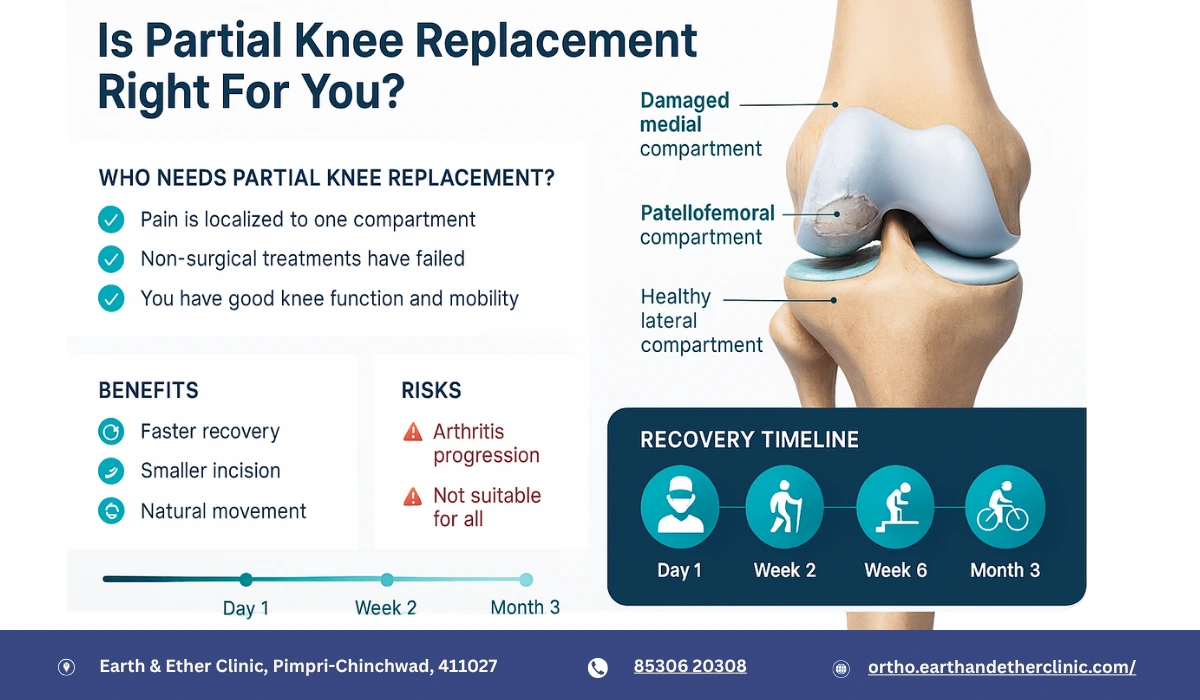
Is Partial Knee Replacement Right For You? Here’s What You Need to Know
Knee pain is one of the most common orthopedic issues affecting adults across all age groups. Whether caused by arthritis, injury, overuse, or age-related wear and tear, knee pain can significantly limit your daily activities and impact your quality of life. For many people, conservative treatments such as medication, physiotherapy, injections, and lifestyle adjustments offer relief. However, when these options stop working, surgical intervention may become necessary.
While total knee replacement (TKR) is widely known, partial knee replacement (PKR) has emerged as a less invasive, highly effective alternative for select patients. If you have been exploring knee surgery options or have been advised to consider knee replacement, understanding how partial knee replacement works—and whether you are the right candidate—is crucial.
This comprehensive guide explains everything you need to know about partial knee replacement, how it differs from total knee replacement, candidacy criteria, benefits, risks, recovery expectations, and how the Best Orthopedic Surgeon in Pune can help you decide if it’s the right treatment.
What Is Partial Knee Replacement?
Partial knee replacement, also called unicompartmental knee replacement, is a surgical procedure in which only the damaged portion of the knee joint is replaced with an implant. Unlike total knee replacement—which replaces the entire knee—PKR focuses on just one of the three compartments of the knee:
- Medial compartment (inner side of the knee)
- Lateral compartment (outer side of the knee)
- Patellofemoral compartment (front of the knee)
Most PKR procedures involve the medial compartment, since it is the most commonly affected. In this surgery, healthy bone, ligaments, and cartilage are preserved, and only the damaged compartment is resurfaced with a prosthetic implant.
Partial Knee Replacement vs. Total Knee Replacement: What’s the Difference?
Many patients are unsure whether they need a partial or total knee replacement. Understanding the differences can help you make an informed decision:
1. Extent of Damage Addressed
- PKR: Only one damaged compartment.
- TKR: Entire knee joint is replaced.
2. Surgical Invasiveness
- PKR is less invasive, requiring a smaller incision.
- TKR is more extensive with a larger operative field.
3. Recovery Time
- PKR patients typically recover much faster.
- TKR requires longer rehabilitation due to the larger area treated.
4. Preservation of Natural Knee
- PKR preserves ligaments and healthy tissues.
- TKR replaces most structures of the knee.
5. Range of Motion
- PKR usually allows for a more natural knee movement after recovery.
6. Lifespan of the Implant
Both surgeries have long-lasting implants, but suitability depends on bone quality, activity level, and alignment.
Who Is the Ideal Candidate for Partial Knee Replacement?
Not everyone with knee pain qualifies for PKR. It is recommended for individuals with:
1. Osteoarthritis Limited to a Single Compartment
The most important criterion is that arthritis must be localized. An orthopedic surgeon determines this using:
- X-rays
- MRI scans (if required)
- Physical examination
2. Intact Knee Ligaments
Cruciate ligaments, especially the ACL, must be healthy and functioning well.
3. Correct Knee Alignment
Severe deformities like bow legs or knock knees may prevent PKR from being successful.
4. Moderate Activity Level
Partial knee replacement is suitable for active adults, but extremely high-impact activities (e.g., running, competitive sports) may affect implant longevity.
5. Chronic Knee Pain Unresponsive to Conservative Treatments
Candidates usually have:
- Persistent pain
- Stiffness
- Functional limitation
- Failed response to physiotherapy or medication
6. No Severe Inflammatory Arthritis
Conditions like rheumatoid arthritis often affect multiple compartments and thus require total knee replacement.
If you’re unsure about your eligibility, consulting the Best Orthopedic Surgeon in Pune can help determine the most appropriate treatment.
Benefits of Partial Knee Replacement
Partial knee replacement is gaining popularity because it offers certain advantages over total knee replacement for appropriately selected patients. Here are the most notable benefits:
1. Smaller Incision and Less Tissue Damage
The surgical approach is minimally invasive. This results in:
- Less post-operative pain
- Reduced bleeding
- Lower risk of complications
2. Faster Recovery
Most patients return to normal activities sooner than with total knee replacement. Many can walk with support on the same day of surgery.
3. Better Knee Function
Because the procedure preserves natural knee structures, the joint feels more natural. This allows:
- Improved range of motion
- More stable knee movement
- Ability to kneel or squat (depending on individual healing)
4. Lower Risk of Complications
PKR has a reduced risk of infection, stiffness, and blood clots compared to TKR.
5. Less Bone Removal
Since only the damaged compartment is removed, more of your natural bone remains intact.
6. Easier Revision If Needed
If the patient later develops arthritis in other parts of the knee, converting PKR to TKR tends to be easier and less complex.
Risks and Limitations of Partial Knee Replacement
Although PKR offers many benefits, it is important to understand the potential risks and limitations:
1. Not Suitable for All Patients
Many patients have arthritis affecting multiple compartments, which makes PKR less effective.
2. Possibility of Disease Progression
Arthritis may eventually affect the remaining compartments, requiring future surgery.
3. Implant Wear or Loosening
Like all joint implants, PKR components may wear out or loosen over time.
4. Residual Pain
Some patients may still experience mild discomfort, especially if arthritis spreads.
5. Surgical Expertise Required
PKR requires precision and experience. Choosing an experienced orthopedic surgeon greatly influences outcomes.
The Partial Knee Replacement Procedure: What to Expect
Here’s a step-by-step overview of how PKR is performed:
1. Pre-Surgery Assessment
Your orthopedic surgeon will:
- Review medical history
- Conduct physical exams
- Order X-rays or MRI
- Discuss benefits, risks, and expected results
2. Anesthesia
The procedure is performed under either:
- Spinal anesthesia
- General anesthesia
3. Surgical Steps
- A small incision is made over the knee.
- Damaged cartilage and bone from the affected compartment are removed.
- Metal and plastic prosthetic components are inserted.
- The incision is closed, and dressing is applied.
4. Duration
Most PKR surgeries take 60–90 minutes.
Recovery After Partial Knee Replacement
Recovery time varies depending on age, health, and activity level, but here’s a general timeline:
1. First 24 Hours
- Patients are encouraged to walk with assistance.
- Physiotherapy begins immediately.
2. First 2 Weeks
- Swelling reduces.
- Range-of-motion exercises improve flexibility.
- Pain is controlled with medication.
3. 2–6 Weeks
- Most patients resume light daily activities.
- Driving may be possible after 3–4 weeks.
4. 6–12 Weeks
- Strengthening exercises enhance stability.
- Patients return to low-impact activities.
5. 3–6 Months
- Most patients experience full recovery.
- Pain-free mobility becomes the norm.
Activities You Can Resume
- Walking
- Cycling
- Swimming
- Golf
- Light gym workouts
Activities to Avoid
- High-impact sports
- Jumping
- Running on hard surfaces
How Long Does a Partial Knee Replacement Last?
Modern partial knee implants are durable and typically last 15–20 years or more with proper care. Factors influencing implant lifespan include:
- Activity level
- Weight
- Bone quality
- Alignment
- Surgical accuracy
With advances in technology and better implant designs, the longevity of PKR has significantly improved over the years.
Partial Knee Replacement Success Rate
Numerous studies show that partial knee replacement has:
- 90–95% success rate
- High patient satisfaction
- Reduced complications compared to TKR
Patients often report that the knee feels more natural due to preserved ligaments.
How to Know If Partial Knee Replacement Is Right for You
You may be an ideal candidate if:
✓ Your pain is mainly on one side of the knee
✓ Your arthritis is not widespread
✓ You have not responded to conservative treatments
✓ Your knee ligaments are intact
✓ Your knee is not severely deformed
✓ You want faster recovery and better knee movement
A detailed evaluation with an orthopedic expert is essential to confirm candidacy.
Tips to Maximize the Success of Partial Knee Replacement
To ensure long-term success:
- Follow your physiotherapy schedule consistently
- Maintain a healthy weight
- Avoid high-impact exercises
- Use knee-friendly techniques for sitting and bending
- Stay active but avoid overloading the joint
Regular follow-ups with your orthopedic surgeon ensure early detection of potential issues.
Conclusion
Partial knee replacement is a highly effective and minimally invasive option for individuals with arthritis limited to one compartment of the knee. It offers faster recovery, improved functionality, and a more natural feel compared to total knee replacement. However, suitability depends on your health, knee structure, and the extent of damage.
If you’re unsure whether PKR is right for you, consulting the Best Orthopedic Surgeon in Pune is the best way to get personalized guidance based on a thorough evaluation. With the right medical expertise and timely intervention, you can regain mobility, reduce pain, and enjoy a more active life.
Read Here: Top 7 Lifestyle Habits to Keep
