
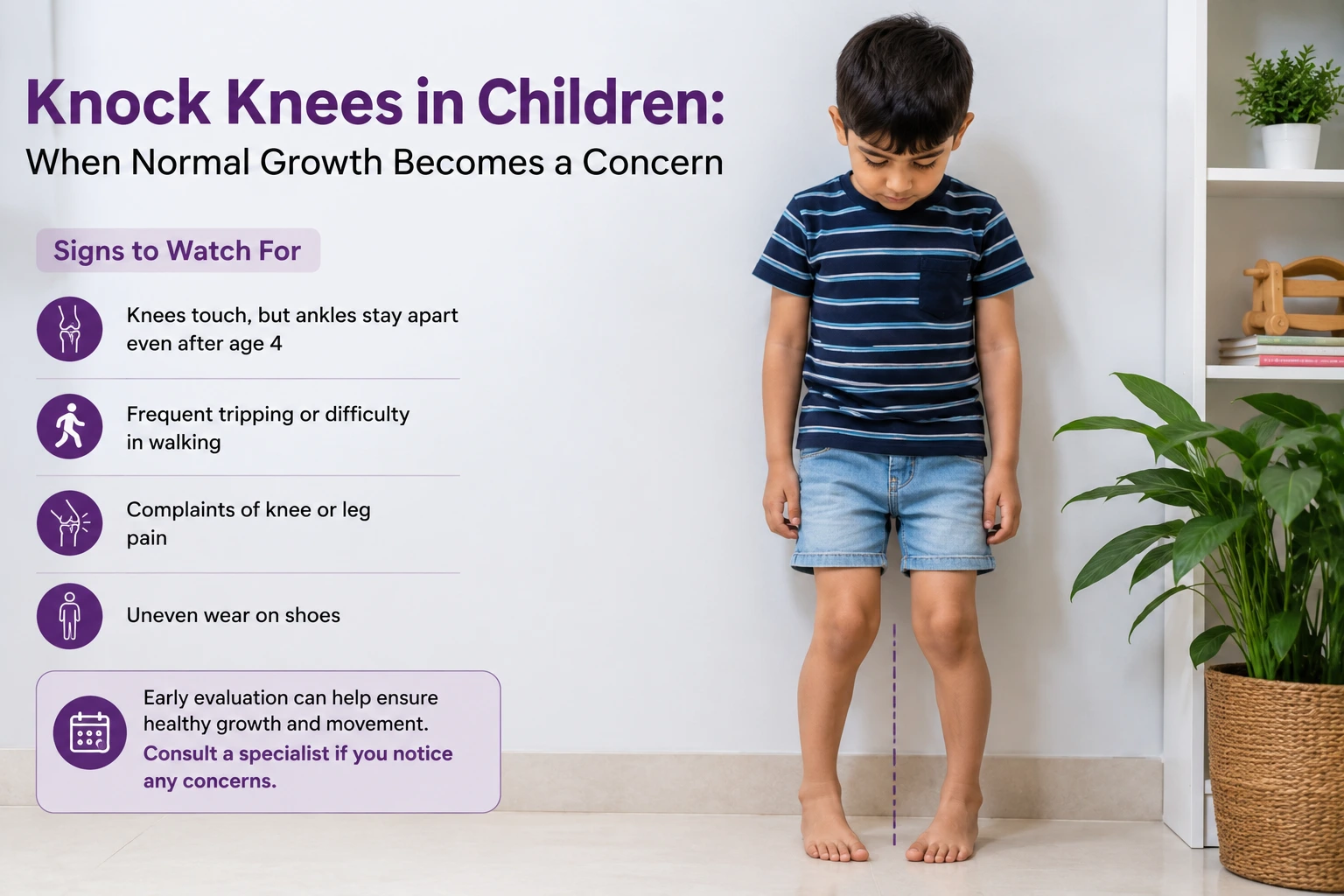
If you’ve noticed your toddler’s knees touching while their ankles stay apart, you’re probably wondering if something is wrong. Take a breath — in most cases, knock knees (medically known as genu valgum) are simply a normal part of childhood development. However, there are situations where this condition signals an underlying issue that needs medical attention. This guide walks you through what’s normal, what’s not, and when it’s time to consult a specialist.
What Are Knock Knees (Genu Valgum)?
Knock knees is a condition where a child’s knees angle inward and touch each other while standing, even when the ankles remain apart. This creates a distinctive “X-shaped” appearance of the legs. It’s one of several natural alignment phases children go through as their skeletal system matures, alongside bow legs (genu varum) in infancy and knock knees typically between ages 2 and 6.
Is It Normal? Understanding the Growth Pattern
Children’s leg alignment changes significantly as they grow:
- Birth to 18 months: Legs are naturally bowed (bow-legged appearance)
- 18 months to 3 years: Legs gradually straighten
- 2 to 6 years: Knock knees develop and are most noticeable around ages 3–4
- 7 to 8 years: Legs usually straighten on their own and reach adult alignment
This progression is a completely natural part of bone and joint development. Most children outgrow knock knees without any treatment by the time they reach seven or eight years old. Parents often panic unnecessarily during this phase, but regular observation is usually all that’s required.
When Does It Become a Concern?
While knock knees are typically harmless, certain signs indicate it’s time to seek professional evaluation:
- The condition persists or worsens after age 7-8
- Noticeable asymmetry — one knee is more angled than the other
- The gap between the ankles exceeds 8-10 cm when knees are together
- Your child complains of knee, hip, or ankle pain
- Difficulty walking, running, or frequent tripping
- Visible limping or an unusual gait
- The child seems unusually short for their age alongside the knee angulation
If any of these symptoms appear, it’s important not to delay a proper clinical assessment, since early intervention often leads to simpler, more effective treatment.
Common Causes of Persistent Knock Knees
When knock knees don’t resolve naturally, several underlying causes may be responsible:
- Rickets – caused by Vitamin D or calcium deficiency, affecting bone development
- Skeletal dysplasia – genetic conditions affecting bone growth
- Injury or fracture – trauma to the growth plate near the knee
- Obesity – excess weight can put additional stress on developing joints
- Blount’s disease – a growth disorder affecting the shinbone
- Metabolic bone disorders – conditions affecting overall bone mineralization
A thorough diagnosis helps identify whether the cause is purely developmental or linked to one of these underlying conditions.
How Is It Diagnosed?
A qualified specialist typically evaluates knock knees through:
- Physical examination of leg alignment and gait
- Measuring the distance between ankles when knees are touching
- X-rays to assess bone structure and growth plates
- Blood tests, if a metabolic or nutritional cause is suspected
- Growth chart review to track the child’s overall development
If you’re searching for a Pediatric orthopedic surgeon in Pune, timely diagnosis by an experienced specialist can help distinguish between a normal developmental phase and a condition requiring intervention.
Treatment Options
Treatment depends entirely on the child’s age, severity, and underlying cause:
Watchful Waiting
For children under 7 with mild, symmetrical knock knees and no pain, doctors usually recommend periodic monitoring rather than immediate treatment, since most cases self-correct.
Nutritional Support
If rickets or a deficiency is identified, Vitamin D and calcium supplementation, along with dietary changes, can help correct the underlying cause.
Bracing
In select cases, orthotic braces may be used to guide bone growth in the right direction, especially in younger children with growth plates still open.
Guided Growth Surgery
For older children with persistent or worsening knock knees, a minimally invasive procedure called guided growth surgery (using small plates near the growth plate) can gradually correct alignment without major surgery.
Osteotomy
In more severe or older cases, a corrective bone-cutting procedure may be required to realign the leg properly.
Why Expert Evaluation Matters
Parents often search online for a Best Orthopedic Surgeon in Pune hoping to find reassurance or answers, but self-diagnosis based on appearance alone can be misleading. A trained eye can differentiate between a passing developmental stage and a condition that needs correction — and catching issues early almost always leads to better outcomes and less invasive treatment.
At Earth & Ether Clinic, under the expert guidance of Dr. Shrirang Kulkarni, children receive a thorough, compassionate evaluation tailored to their growth stage. Whether it’s simple monitoring or a structured treatment plan, every recommendation is based on precise clinical assessment rather than guesswork.
If you’re based nearby and looking for a Best Orthopedic Doctor Near Me, especially one experienced in treating growing children, a specialist consultation can offer peace of mind and a clear path forward. Families across the region, including those searching for a Best Orthopedic Doctor in Pimpri Chinchwad, trust experienced pediatric specialists to guide them through this often confusing phase of their child’s development.
For parents seeking a Pediatric Orthopedic Surgeon Near Me, it helps to choose a clinic that specializes specifically in growing bones and joints rather than general orthopedic care, since children’s musculoskeletal needs are very different from adults’.
Choosing the Right Specialist in Pune
Pune has grown into a hub for advanced pediatric orthopedic care, with several experienced specialists available across the city. If you’re consulting a pediatric orthopedic consultant in Pune, look for someone with dedicated experience in childhood growth disorders, not just general orthopedic training.
Families residing in the western suburbs often search for pediatric orthopedic in Pimpri Chinchwad to avoid long commutes while still accessing specialized care close to home. Similarly, residents nearby frequently look for an Orthopedic Doctor in Rahatani who understands both adult and pediatric musculoskeletal concerns.
For focused, child-specific expertise, many parents specifically search for pediatric orthopedic in Rahatani, preferring a specialist who regularly treats conditions like knock knees, bow legs, and other growth-related concerns in a comfortable, child-friendly clinical setting.
Prevention and Home Care Tips
While not all cases can be prevented, these habits support healthy bone development:
- Ensure adequate Vitamin D exposure and dietary intake
- Maintain a balanced, calcium-rich diet
- Encourage age-appropriate physical activity
- Monitor your child’s weight to avoid excess joint stress
- Schedule regular pediatric check-ups to track growth milestones
Frequently Asked Questions (FAQs)
Q1: At what age should I worry about my child’s knock knees?
If knock knees persist beyond age 7-8, worsen over time, or cause pain and difficulty walking, it’s time to consult a specialist.
Q2: Can knock knees correct themselves without treatment?
Yes, in most children under 7, knock knees resolve naturally as part of normal skeletal development.
Q3: Is knock knees a sign of a serious disease?
Not usually. Most cases are developmental. However, persistent or severe cases can occasionally indicate rickets, Blount’s disease, or other bone disorders that need evaluation.
Q4: Does being overweight cause knock knees?
Excess weight can worsen existing knock knees or slow natural correction by placing added stress on the knee joints.
Q5: Is surgery always required for knock knees?
No. Surgery is only considered in severe, persistent, or worsening cases. Most children are managed with observation or non-surgical methods.
Q6: How is knock knees different from bow legs?
Bow legs cause the knees to angle outward with ankles touching, while knock knees cause the knees to touch with ankles apart. Both are common at different developmental stages.
Conclusion: When to Take the Next Step
Knock knees are a common, often harmless part of growing up — but knowing when to seek expert advice can make all the difference for your child’s long-term joint health. If your child’s knock knees persist past age 7, cause discomfort, or seem unusually severe, don’t wait for it to resolve on its own.
Book a consultation with Dr. Shrirang Kulkarni at Earth & Ether Clinic today for a comprehensive evaluation and a personalized care plan designed around your child’s unique growth journey. Early assessment brings clarity, confidence, and the right treatment path — right when your family needs it most.
